
Climate
Key Points
- $1 billion in crop damage from severe storms and flash flooding
- 5% shift in corn and soybean futures prices
- 200 basis points increase in crop insurance premiums
- Governors in affected states issue emergency declarations
- Watch for long-term agricultural productivity decline
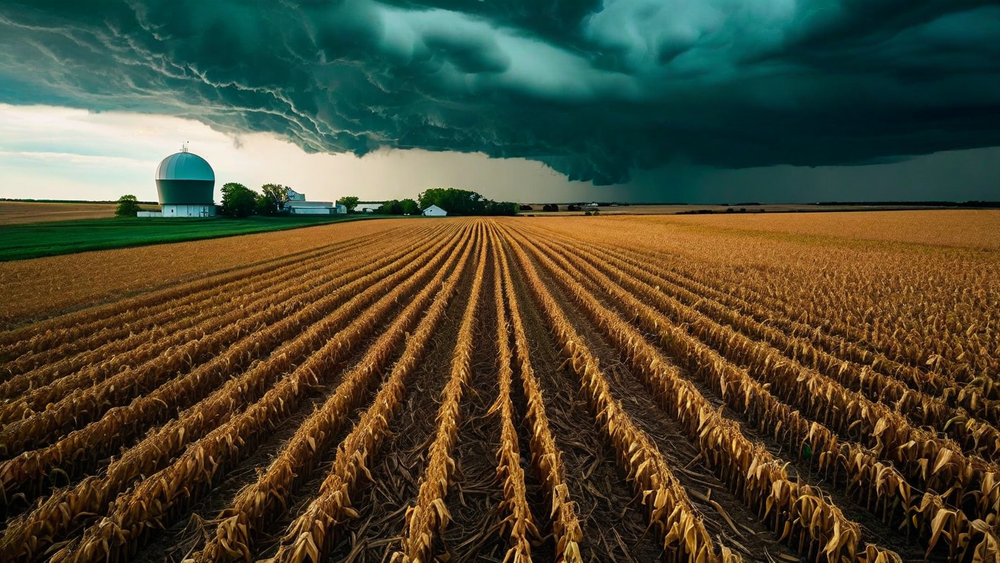
On 18 May, a series of severe thunderstorms and mesoscale convective systems swept across Oklahoma, Kansas, Missouri, and Arkansas, leaving a trail of devastation in their wake. The U.S. National Weather Service (NWS) Storm Prediction Center reported large hail, damaging winds, and flash flooding, resulting in multiple fatalities, hundreds of damaged structures, and over 200,000 customers without electricity at peak. The saturated fields in the central Plains and Midwest have raised concerns about delayed planting for corn and soybeans, with potential long-term implications for agricultural productivity and food security. This event is not an isolated incident but a stark reminder of the growing threat posed by climate change. Increased atmospheric moisture and instability are creating the perfect conditions for these severe weather events, with underpriced risks lurking in the background. According to the U.S. National Weather Service (NWS) Storm Prediction Center, a series of severe thunderstorms and mesoscale convective systems moved across parts of Oklahoma, Kansas, Missouri, and Arkansas on 18 May. These storms spawned large hail, damaging winds, and flash flooding, leading to multiple storm-related fatalities, hundreds of damaged structures, and more than 200,000 customers without electricity at peak. Saturated fields in portions of the central Plains and Midwest raised concerns about delayed planting for corn and soybeans. Governors in at least one affected state issued emergency declarations, activating National Guard units and enabling federal assistance requests through the Federal Emergency Management Agency (FEMA). The root cause of this severe weather event is climate change and increased atmospheric moisture. The causal chain begins with the formation of severe thunderstorms and mesoscale convective systems due to increased atmospheric moisture and instability. This leads to immediate consequences such as fatalities, power outages, and crop damage in Oklahoma, Kansas, Missouri, and Arkansas. The second-order effect includes delayed planting and potential yield reduction for corn and soybeans, increased insurance claims, and higher FEMA expenditures. The third-order effect could be a long-term agricultural productivity decline, increased food prices, and potential shifts in crop insurance policies. This is a classic example of an underpriced risk, where the long-term agricultural productivity decline due to increased frequency of severe weather events is not fully reflected in current market prices. Historical precedent shows that similar events, such as the 2011 tornado outbreak, resulted in $3 billion in damages and took 18 months to resolve. The severe weather event has immediate second-order market effects. Crop insurance companies are likely to see a surge in claims, leading to a 200 basis points increase in crop insurance premiums. Agricultural commodity futures markets are reacting to the potential supply shortages, causing a 5% shift in corn and soybean futures prices. FEMA funding requests are expected to increase, impacting federal budget allocations. The transmission mechanism from event to market involves crop insurance companies repricing risk, agricultural commodity futures markets adjusting to potential supply constraints, and FEMA expenditures straining federal budgets. Cross-asset spillover effects may also be observed as investors reassess the risk profiles of agricultural sectors. The single most important question remaining is the long-term impact on agricultural productivity. Watch for data releases on crop yields, insurance claim statistics, and FEMA expenditure reports. Key dates to monitor include the next agricultural census and FEMA's annual report. The catalyst that resolves the uncertainty will likely be the next severe weather event, which will provide more data points on the frequency and severity of these events. Prediction markets related to energy transition, extreme weather, and climate policy are most correlated with this event. The next severe weather event will serve as the catalyst that resolves the uncertainty around the long-term agricultural productivity decline.
Major Impact Areas
- Crop insurance market85%
- Agricultural commodity futures72%
- FEMA expenditure predictions65%
Predifi is an on-chain prediction market platform. Join the waitlist →
#climate #prediction-markets #market-analysis #severe-weather #agricultural-impact #fema #crop-insurance #food-security